
The Five-Year-Old Who Wouldn’t Open Her Mouth
A mother brought her five-year-old daughter to our Rabindra Nagar clinic with a badly decayed upper back tooth. The child had been in pain for a week and had barely eaten for two days.
She would not open her mouth. Not for me, not for her mother, not for anything.
The reason came out slowly. Four months earlier, at another clinic, she had been held down while a tooth was examined. Nobody had explained anything to her beforehand. She had cried, been told to stop crying, and the appointment had been completed anyway.
That single visit had cost her a tooth — because for four months afterwards, her mother could not get her through a clinic door.
We did not treat her that day. We did almost nothing at all. She sat in the chair, rode it up and down, held the mirror, and looked at her own teeth on the screen. She left with a sticker and no treatment.
She came back four days later and let me count her teeth. On the third visit we treated the tooth.
Three appointments instead of one. Her mother took time off work twice more than she should have needed to. And it was worth every minute — because that child is now eight, comes in twice a year, and is not afraid of dentists.
That is the difference a good children’s dental appointment makes. And it is not something you can judge from a Google listing.
Why “Nearest” and “Best” Are Not the Same Thing
When a child has a toothache at ten at night, every parent searches the same thing: a dentist nearby, open soon, who treats children.
Proximity matters — genuinely. A clinic twenty minutes away that your child tolerates is better than an excellent one two hours away that you will only visit in emergencies. Regular, easy, routine visits are what actually protect children’s teeth.
But distance should be one filter among several, not the only one. Here is what actually matters.
What to Look For
1. Qualifications — and which ones are relevant
In India, a dentist holds a BDS. A specialist holds an MDS in a particular branch.
- MDS in Pedodontics and Preventive Dentistry is the branch dedicated specifically to children’s dentistry
- MDS in Orthodontics covers alignment, jaw growth and bite development, much of which is done in childhood
- Many experienced BDS practitioners treat children extremely well
What this means practically: for a routine filling, a sealant, or a check-up, a good general dentist or any experienced MDS is entirely appropriate. For a child with severe anxiety, special needs, or extensive decay needing sedation, a pedodontist is the right referral — and a good clinic will tell you so rather than attempt it.
Where we stand, plainly: I am an MDS Orthodontist. I treat children routinely, and orthodontic and growth assessment is my own specialty area. Where a case genuinely calls for a pedodontist, I say so and refer. A clinic that claims every specialty is a clinic to be sceptical of.
2. How they behave in the first five minutes
This tells you more than any credential.
Good signs:
- Speaks to your child directly, not only to you
- Explains what will happen in words a child understands before doing it
- Lets the child touch the mirror, the chair, the suction
- Accepts that the first visit may achieve nothing, and says so without irritation
- Uses “tell-show-do” — describe it, demonstrate it, then do it
Warning signs:
- Restraining a child without discussion
- “Stop crying,” “don’t be a baby,” “be brave”
- Rushing straight to treatment on a first visit
- Threatening the child with the injection or the drill
- Talking about the child as if they are not in the room
A child’s first few dental visits set their attitude for decades. A dentist who wins the appointment but loses the child has not done the job.
3. Whether they measure success in prevention
Ask what they will do to stop the next cavity. A clinic focused on children should talk about fluoride application, pit and fissure sealants on new permanent molars, brushing technique, feeding and bottle habits, and diet.
If every visit ends in a filling and nothing changes, something is missing.
4. Whether they will tell you a tooth can be left alone
Not every mark on a baby tooth needs drilling. Some early decay can be arrested and monitored, and some baby teeth close to falling out naturally do not warrant intervention.
A dentist willing to say “let’s watch this one” is demonstrating judgement, not laziness. It is one of the more reliable signals you will get.
5. Practical fit
Timings that work around school. A location you can reach easily when something goes wrong. Clear information on cost before treatment. Reasonable emergency access.
When Your Child Should First Be Seen
By the first birthday, or within six months of the first tooth appearing. Much earlier than most parents expect.
That first visit is not really about treatment. It is about checking development, discussing bottle and feeding habits, showing you how to clean a very small mouth, and — critically — making a dental clinic an ordinary place rather than somewhere you only go when something hurts.
Then every six months, adjusted on advice.
The one appointment parents almost always miss
Around age seven, your child should have an orthodontic assessment — even if the teeth look fine.
This is my own specialty, so let me be specific about why it matters. By seven, the first permanent molars and incisors are usually in, and the shape of the developing bite becomes readable. At that age some problems can be intercepted while the jaws are still growing:
- Crossbites, which can shift the jaw and wear teeth unevenly
- Severe crowding, where creating space early reduces later treatment
- Thumb sucking or tongue thrusting habits affecting tooth position
- Protruding upper front teeth, which are significantly more prone to injury
- Impacted or missing permanent teeth, visible on an X-ray long before they cause trouble
Most children assessed at seven need nothing at all beyond monitoring. But the small number who do benefit enormously from being caught early — and that is why the assessment is worth doing.
What a Good Appointment Looks Like
- Nothing happens on the child’s face without a warning. Everything is explained first.
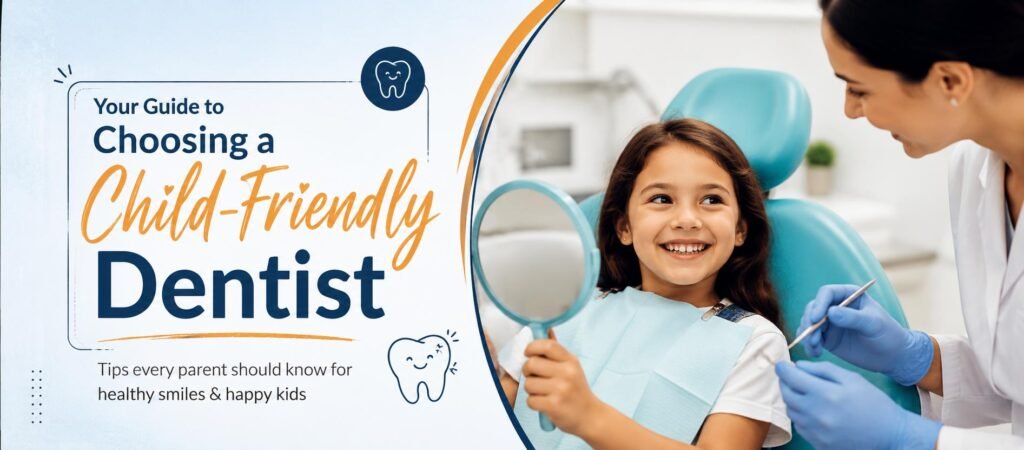
- The child holds a mirror. Watching is far less frightening than not knowing.
- Small steps. Counting teeth, then a polish, then a check — building tolerance in stages.
- Honesty. We do not tell a child something will not feel like anything if it will. Break trust once and you do not get it back.
- A stop signal. The child can raise a hand and we stop. Being able to stop is what makes children able to continue.
- Ending well. Even a difficult appointment ends on something the child managed.
Parents are welcome throughout. Some children do better with a parent holding their hand; some do noticeably better when the parent sits slightly back. We will read your child and suggest which — and you decide.
Questions Worth Asking Before You Book
- What qualification does the dentist hold, and which branch?
- How do you handle a frightened child?
- Do you allow parents in the treatment room?
- What do you do preventively — sealants, fluoride, diet advice?
- Will you tell me if a tooth can be monitored instead of treated?
- What are the timings, and what happens in an emergency?
- Will I have the cost in writing before treatment?
A clinic confident in how it treats children will answer all of these easily.
Two Things Parents Get Told That Are Wrong
“They’re only baby teeth.” Baby teeth hold space for the permanent teeth behind them. Losing one early lets neighbouring teeth drift into the gap, and the permanent tooth arrives with nowhere to go — which is a common route into orthodontic treatment that could have been avoided. They also matter for chewing, speech and sleep. Infection in a baby tooth can damage the permanent tooth developing directly above it.
“Wait until all the permanent teeth are in before seeing an orthodontist.” For many children this is fine. For a subset it is too late — particularly crossbites and jaw growth discrepancies, which are far easier to correct while the child is still growing. Hence the assessment at seven.
Come In Before There’s a Problem
The best first dental visit is a boring one, with nothing wrong and nothing to do. That is the visit that makes every future visit easy.
Dr. Somnath Pal — Dental Mid World, Multispecialty Dental Clinic
Children’s dental check-ups · Fillings and pulpectomy for milk teeth · Fluoride application and sealants · Early orthodontic assessment · Braces and habit-breaking appliances · All treatments by MDS specialists
Clinic 1: Rabindra Nagar, beside Nirnoy Hospital, opposite Aurobindo Stadium Gate No. 1, Medinipur Clinic 2: Satbankura, Shanti Nagar Colony, Chandrakona Road, beside State Bank of India
Phone: +91 98315 31055 · +91 94747 23106 · WhatsApp: +91 92394 54722
Timings: Tue, Wed, Fri, Sat — 11am to 7:30pm | Sun & Mon (C.K. Road clinic) — 11am to 4pm
Serving families across Medinipur, Rabindra Nagar, Chandrakona Road, Satbankura and Paschim Medinipur.
Frequently Asked Questions
1. When should my child first see a dentist?
By the first birthday, or within six months of the first tooth appearing. The visit is mostly about checking development, discussing feeding and bottle habits, and making the clinic feel ordinary rather than frightening. Check-ups then continue about every six months.
2. What is the difference between a pediatric dentist and a general dentist?
A pediatric dentist, or pedodontist, holds an MDS in Pedodontics and Preventive Dentistry — a branch focused specifically on children. Many general dentists and other MDS specialists treat children very well. For routine care either is appropriate; for severe anxiety, special needs, or extensive treatment requiring sedation, a pedodontist is the right referral.
3. Do baby teeth really need treatment if they’ll fall out anyway?
Yes. Baby teeth hold space for the permanent teeth behind them, and losing one early lets neighbouring teeth drift, leaving the permanent tooth without room. They also matter for chewing, speech and sleep, and infection in a milk tooth can affect the permanent tooth developing above it.
4. At what age should a child see an orthodontist?
Around age seven, even if the teeth look fine. By then the developing bite can be assessed and problems such as crossbites, severe crowding, or habit-related tooth position can be intercepted while the jaws are still growing. Most children need only monitoring; the few who need early treatment benefit substantially.
5. My child is terrified of the dentist. What should I do?
Tell the clinic before you arrive, so the appointment can be planned differently — slower pace, more explanation, and no expectation of completing treatment on the first visit. Avoid words like “pain,” “needle” or “hurt” at home, and don’t use dental visits as a threat for bad behaviour.
6. Can I stay with my child during treatment?
At our clinic, yes. Some children do better with a parent beside them; some are noticeably calmer when the parent sits slightly back. We will suggest what seems to suit your child, and the decision is yours.
7. Is dental X-ray safe for children?
Yes, when clinically justified. Modern digital X-rays use markedly less radiation than older film, and we take them only when they will change what we do — such as checking for decay between teeth or assessing permanent teeth that have not yet erupted.
8. What are sealants, and does my child need them?
Sealants are a thin protective coating applied to the grooved chewing surfaces of permanent back teeth, where most childhood decay begins. They are painless, require no drilling, and are among the most effective preventive measures available. They’re typically applied soon after the first permanent molars appear, around age six.
9. How do I stop my child getting cavities?
Brush twice daily with an age-appropriate fluoride toothpaste, supervising until around age seven or eight. Limit sugary drinks and frequent snacking — frequency matters more than quantity. Avoid bottles of milk or juice at bedtime, and keep six-monthly check-ups so early decay is caught while it is still small.
10. What should I do if my child knocks out a tooth?
For a permanent tooth, hold it by the crown rather than the root, rinse briefly in milk or saline if dirty, and either reinsert it into the socket or transport it in milk — then reach a dentist immediately. Time is critical. For a knocked-out baby tooth, do not reinsert it, but still have the child seen promptly.
11. Does my child need to be treated by a specialist for a simple filling?
Not necessarily. A routine filling, cleaning, fluoride application or sealant is well within the scope of an experienced general or specialist dentist. What matters more for a straightforward procedure is how the clinic handles children, not which branch of MDS the dentist holds.
12. What if my child needs treatment your clinic doesn’t provide?
We will tell you and refer you appropriately. Cases needing sedation or general anaesthesia, or children with complex medical or special needs, are best managed by a pedodontist with the right setup. Referring is part of good care, not a shortcoming.